

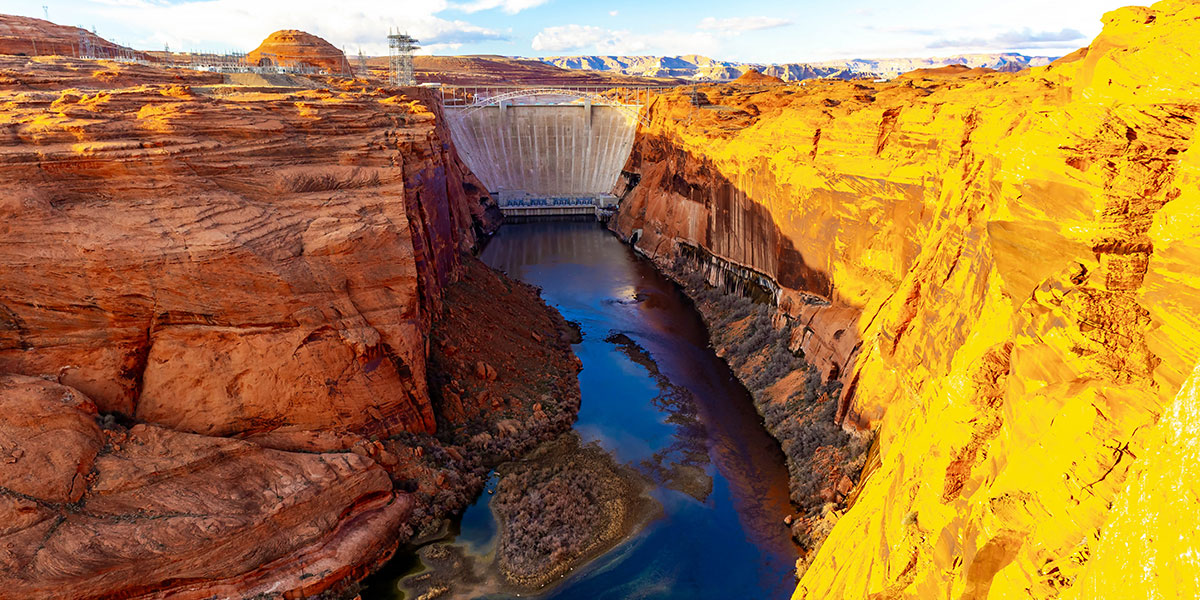
The Colorado River is experiencing what may be the worst water year on record. These extreme dry conditions are causing additional strain on Lakes Powell and Mead, the largest reservoirs on the Colorado River.
The Colorado River is shared by seven states and Mexico. It provides water for 43 million people, including 30 tribal communities, and gives life to urban centers, agricultural heartlands and ecological habitats. The river supports nearly $4 trillion in economic output and is key to the nation’s economy. The Lower Basin (Arizona, California and Nevada) is the region where 75% of the population, employment, crop sales and 25 of the 30 tribal communities are located.
The success of the river basin depends on good management of a complex and fragile system. Water users in the Lower Basin have reduced uses and saved what amounts to 160 feet in elevation in Lake Mead, but additional actions are needed in the extreme dry conditions facing the system today. Fortunately, there are many reservoirs strategically placed across the watershed to protect the river and those who rely on it in dry years like this one.
The federal government has announced that it intends to wield these reservoirs and release 1 million acre feet of water from the Upper Initial Units, with the caveat that this release may be reduced by almost 40%. Also announced was a reduction to 2026 releases to the Lower Basin, cutting flows from Lake Powell to Lake Mead by 1.48 million acre-feet.
The use of the Upper Initial Units is encouraging but not enough. Those reservoirs have been held unreasonably high for years while Lake Powell and Lake Mead were allowed to drop to crisis levels. It is critically important that the federal government make full use of the water currently held in the Upper Initial Units to stabilize the system. The Upper Initial Units were built by the federal government for the purpose of ensuring the entire Colorado River Basin could survive dry years like this one, and they must be fully utilized as such.
Increasing the releases from the Upper Initial Units alone will not solve this problem, nor will simply reducing releases to the Lower Basin. Being downstream, the Lower Basin bears the entire burden of all federally imposed reductions to Glen Canyon Dam releases, while the Upper Basin (Colorado, New Mexico, Utah, and Wyoming) faces no required cuts and, in wetter years, the Upper Basin can actually increase its uses of the river, further cutting into Lower Basin supplies.
We encourage Reclamation to take the lead by fully utilizing the Upper Initial Unit storage and establishing an equitable solution to the current crisis that does not unduly burden the Lower Basin states.